What are Fundflow and Odoo?
Fundflow is a fundraising CRM built on the Salesforce platform, specifically for nonprofit organisations that raise funds. It brings donor management, campaigns, gift tracking and tax receipts together in one environment, aligned with Belgian and European regulations. Fundflow focuses exclusively on fundraising activities and does not cover back-office processes such as accounting, HR or project management.
Odoo is a Belgian ERP system built primarily for commercial businesses. It includes a CRM module, an accounting module, project management, HR and dozens of other applications. There is no dedicated nonprofit edition; organisations that want to use Odoo for fundraising adapt the generic system to their own needs. Worth noting: Salesforce, the platform on which Fundflow runs, can also cover a wide range of business processes through additional modules, but that requires separate configuration and additional licences beyond the fundraising layer.
That distinction runs through every comparison: a platform built for a sector versus a platform that can be adapted for one.
Pricing: more than a number per user
What does Odoo cost?
Odoo offers two paths. The
Community edition is free and open source, but you run everything yourself: hosting, updates, security and technical support. In practice that means additional costs for servers or managed hosting (estimate €30 to €50 per month for a small environment), plus a technical resource to keep it running.
The
Enterprise edition currently costs roughly
€19 to €25 per user per month for the standard plan, depending on region and billing cycle. That includes hosting, support and updates. There is
no nonprofit discount: Odoo charges commercial businesses and charities the same rates.
What does Fundflow cost?
Fundflow is built on the Salesforce platform, and recognised nonprofit organisations are eligible for the
Salesforce Agentforce Nonprofit programme. Through this programme, qualifying organisations receive up to ten free Enterprise licences, with a market value of over €10,000 per year. Additional licences are available at roughly 80% off the commercial price.
Fundflow adds a product layer on top that delivers nonprofit logic out of the box: donor management, campaigns, fiscal compliance. You pay for Fundflow itself, but the underlying infrastructure is largely free or heavily discounted for small and medium-sized organisations.
What does the real cost look like?
An honest comparison looks beyond the licence price. It also has to account for what a system delivers ready to use and what still needs to be added. Odoo requires partner work for most nonprofit-specific functionality, and that adds up. Fundflow delivers that functionality as standard.
Implementation: how quickly are you up and running?
Odoo: flexible, but dependent on customisation
Odoo is a broad platform with many capabilities, and that breadth has a downside. A basic single-module implementation takes four to eight weeks. Once you combine several modules, adapt the system to your nonprofit processes or migrate data from spreadsheets or a legacy system, the timeline typically stretches to three to six months.
For most organisations,
a certified Odoo partner is essential. That partner configures the system, builds any custom features and guides the transition. Implementation costs start around €4,500 for smaller projects and quickly reach €15,000 to €30,000 or more for mid-sized organisations, depending on scope.
This is not an argument against Odoo, but it is something to plan for honestly when setting a budget.
Fundflow: built around a structured approach
Fundflow is designed from the ground up for nonprofit organisations that raise funds. The core processes (registering donors, tracking gifts, managing campaigns, generating tax receipts) are already built in. You configure the system to your way of working; you do not build it from scratch.
In practice that means a shorter implementation timeline and less risk of unexpected costs. The guidance is aimed at fundraisers, not IT specialists.
Fundraising capabilities: what it actually comes down to
Donor management and campaigns
Odoo has a fully functional CRM module. You can register contacts, maintain gift histories, send email campaigns and link donations to projects or analytical accounts. For basic operations that is perfectly serviceable.
Where Odoo falls short is in the concepts fundraisers rely on every day. Recurring gifts, soft credits, fundraising-specific segmentation, major donor stewardship journeys: these are things you need to add through customisation or additional modules. It is possible, but it takes configuration work that someone has to do and maintain.
Fundflow starts from that logic. The terminology, the processes and the reporting are shaped around how fundraisers actually think and work.
Tax receipts: a Belgian compliance requirement
For Belgian organisations, managing tax receipts is not optional. Every recognised vzw or foundation that receives gifts of €40 or more must provide each donor with a tax receipt (model 281.71) and file the data with the FPS Finance via Belcotax-on-web.
For gifts made from 1 January 2024, there is also an obligation to include the donor's national registry number on the filing. That number becomes
mandatory on all fiscal filings from 1 January 2028. And for gifts made from 2025 onwards, the tax benefit for donors dropped from 45% to 30%, which is worth reflecting in how you communicate with your donors.
Odoo has no out-of-the-box solution for this. The existing community modules for donations generate a generic tax receipt with no Belgian layout, no national registry number field and no Belcotax XML export. To make this work in Odoo, you need a partner to build it specifically for you: additional time, additional budget and ongoing dependence on external expertise.
As an interim workaround, the FPS Finance offers the free BowConvert71 tool, which converts gift data from Excel into the required format. That works for small volumes, but it is not a long-term solution that scales.
Fundflow integrates the creation and management of tax receipts as part of the platform, aligned with Belgian regulations. You work from your donor data without manual intermediate steps.
Recurring gifts and reporting
Odoo supports recurring gifts through the Subscriptions module (Enterprise) or through open-source add-ons, but this requires configuration and in some cases manual steps each month. Reporting is available through pivot tables and analytical dashboards, but fundraising-specific KPIs such as retention rates, average gift size by segment or campaign return are not included as standard.
Fundflow offers reporting built around what a fundraiser or director actually needs: not just what came in, but who gives, how loyal your donors are and how campaigns contribute to your overall strategy.
SEPA Direct Debit: managing direct debit collections
For organisations that collect fixed monthly or annual amounts directly from donors' bank accounts, SEPA Direct Debit is a core part of daily operations.
In Odoo, technical support is available through both the native Enterprise module and OCA community add-ons. The process works like this: you register each donor's IBAN, create a mandate per donor, print it for signature, validate it in the system once signed, and then link each gift to the correct mandate. When you want to run a batch collection, Odoo generates an XML file in SEPA PAIN format that you upload manually to your banking application. After the bank processes it, you import the statement and reconcile the payments.
That is a workable approach, but it involves a lot of steps. Mandate management is entirely manual: every IBAN change, every new mandate, every suspension requires a separate action. Mandates also expire automatically after 36 months of inactivity, which is something you need to track yourself. For organisations with hundreds or thousands of direct debit donors, that demands consistent and careful administration.
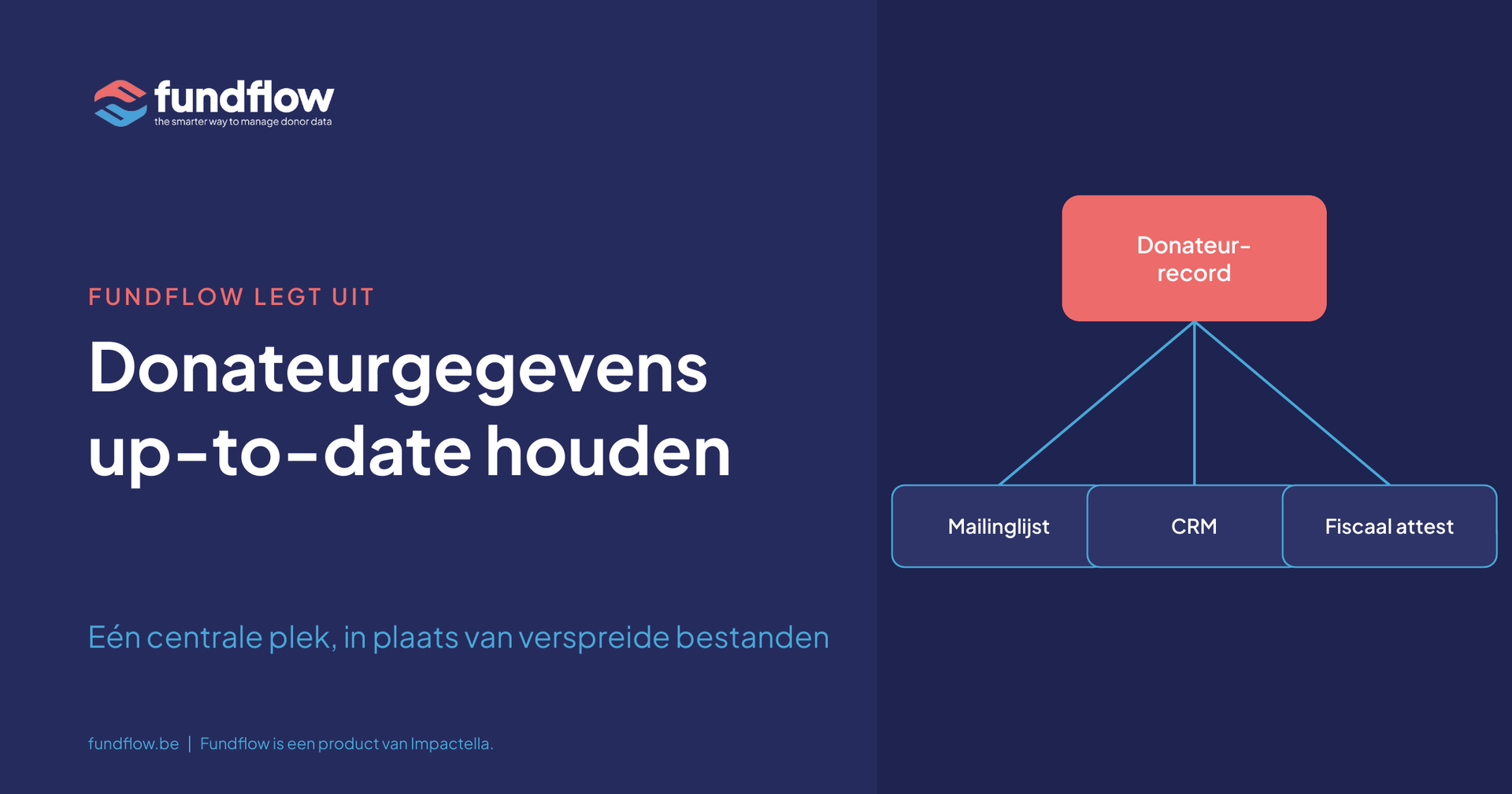
In Fundflow, SEPA Direct Debit is integrated through payment providers that support the SEPA protocol. The mandate sits directly on the donor record, capturing who gives, through which payment method, with which IBAN, for what amount and at what frequency. Any changes to a direct debit are tracked in the donor's file, so the full payment history is always visible from one screen. There is no separate bank file to upload or retrieve manually.
Automatic matching of gifts to donors and campaigns
Every fundraiser knows the problem: there is a deposit in the account, but from whom? And for which campaign?
Odoo handles this through a bank reconciliation function with configurable matching rules. The system compares incoming transactions against existing records based on the payment reference, IBAN or partner name, and suggests a match. This works well when a donor includes a structured reference or their name clearly. For direct debit collections where the IBAN is already known, Odoo can reconcile automatically.
The limitation sits in what happens after the match. Odoo records the transaction as an accounting entry. Linking it to a campaign or fundraising appeal happens through analytical accounts or tags, which need to be set up in advance. That is technically valid, but it is not how fundraisers think. They want to know how much came in from the spring appeal, the October mailing or the year-end campaign, without opening the accounting module to find out. Unknown donors (people with no existing record in the system) are not created automatically either. Those cases sit as unreconciled transactions until someone works through them manually.
In Fundflow, the matching logic is built around the donor and the campaign. Incoming payments are linked to donor profiles based on IBAN, name or structured reference. When a known donor is recognised, the gift is automatically posted to their record, including campaign attribution. For unknown deposits, the system offers a clear overview to create new donors or assign transactions, so nothing disappears into an accounting queue waiting to be found.
The practical difference is one of starting point: in Odoo, processing begins in the accounting module and eventually connects to the CRM. In Fundflow, it starts with the donor and the campaign, and the accounting entry is what closes the loop.
When does Odoo make sense?
Odoo is a strong choice for organisations looking for one platform to cover all their operational processes: accounting, project management, invoicing, HR and a basic CRM. If fundraising is a relatively small part of what you do, and you already have a separate tool for tax receipts or email, Odoo can be a perfectly reasonable option.
It also makes sense if your organisation has the in-house technical capacity to manage and customise the system over time.
When does Fundflow make sense?
Fundflow is the better choice for organisations where
fundraising is the core activity. If donors, gifts, campaigns and fiscal compliance are what your work revolves around, then Odoo asks you to pay for a general-purpose system and then rebuild it around your context. Fundflow starts from that context.
The combination of heavily discounted Salesforce infrastructure through the Agentforce Nonprofit programme, built-in Belgian compliance for tax receipts and fundraising-specific functionality makes Fundflow the more practical choice for most recognised nonprofit organisations in Belgium.
Summary