Jouw non‑profit groeit. Je CRM groeit niet mee.

Kris Van Kerkhoven • 12 June 2026

Share this article

De verborgen kost van een CRM dat je organisatie niet meer kan bijbenen.

Er is een moment dat bijna elke fondsenwerver herkent.


Het is maandagochtend. Je hebt drie Excel-bestanden open, een export uit je oude database, en een bericht van een collega die vraagt of "de lijst voor de jaareindcampagne al klaar is." Je weet dat de data ergens staat. Alleen niet welke versie de juiste is.


Ondertussen blijft je donateursbestand groeien. Meer campagnes, meer contacten, meer inkomsten. Goed nieuws, zou je denken. Maar het systeem dat vroeger 2.000 donateurs aankon, kraakt onder het gewicht van 8.000.


Dit is geen uitzonderlijke situatie. Het is een patroon dat ik bij tientallen organisaties zie.


Hoe het begint


De meeste kleine nonprofits starten met wat voorhanden is: een spreadsheet, een eenvoudige database, soms CiviCRM omdat het gratis is en iemand het ooit heeft opgezet. Dat werkt. Een tijdje.


Dan groeit de organisatie. Nieuwe medewerkers komen erbij. Een tweede campagnekanaal wordt toegevoegd. SEPA-domiciliëringen komen in beeld. Fiscale attesten moeten de deur uit. Plots werken drie mensen in dezelfde database zonder te weten wat de anderen hebben gewijzigd.


Dubbele records verschijnen. Adressen kloppen niet meer. Attesten gaan naar de verkeerde persoon. Een donor die vijf jaar trouw heeft gegeven, krijgt een "welkom, nieuwe donor"-e-mail.

Het systeem draait nog. Maar het draait niet goed meer.


Wanneer begint een systeem je te hinderen?


Niet op het moment dat er iets spectaculair misgaat. Dat valt meteen op. De langzame achteruitgang is het echte probleem.


Herken je dit? Je team besteedt meer tijd aan databeheer dan aan contact met donateurs. Een rapport produceren is een project op zich, geen routine. Elke campagne vereist een handmatige export en opkuis. Nieuwe medewerkers raken gefrustreerd omdat ze geen touw aan de data kunnen vastknopen. Je weet niet welke donateurs op het punt staan te afhaken.


Als drie van deze vijf punten kloppen, groeit jouw nonprofit al een tijdje zonder dat het systeem meegroeit.


De migratiemythe


"Overstappen naar een beter systeem kost ons maanden."

Dat klopt voor maatwerk-implementaties. Organisaties die een Salesforce-consultant inschakelen voor een project op maat, zijn soms zes tot twaalf maanden bezig voor ze live gaan.

Maar dat is niet de enige weg.


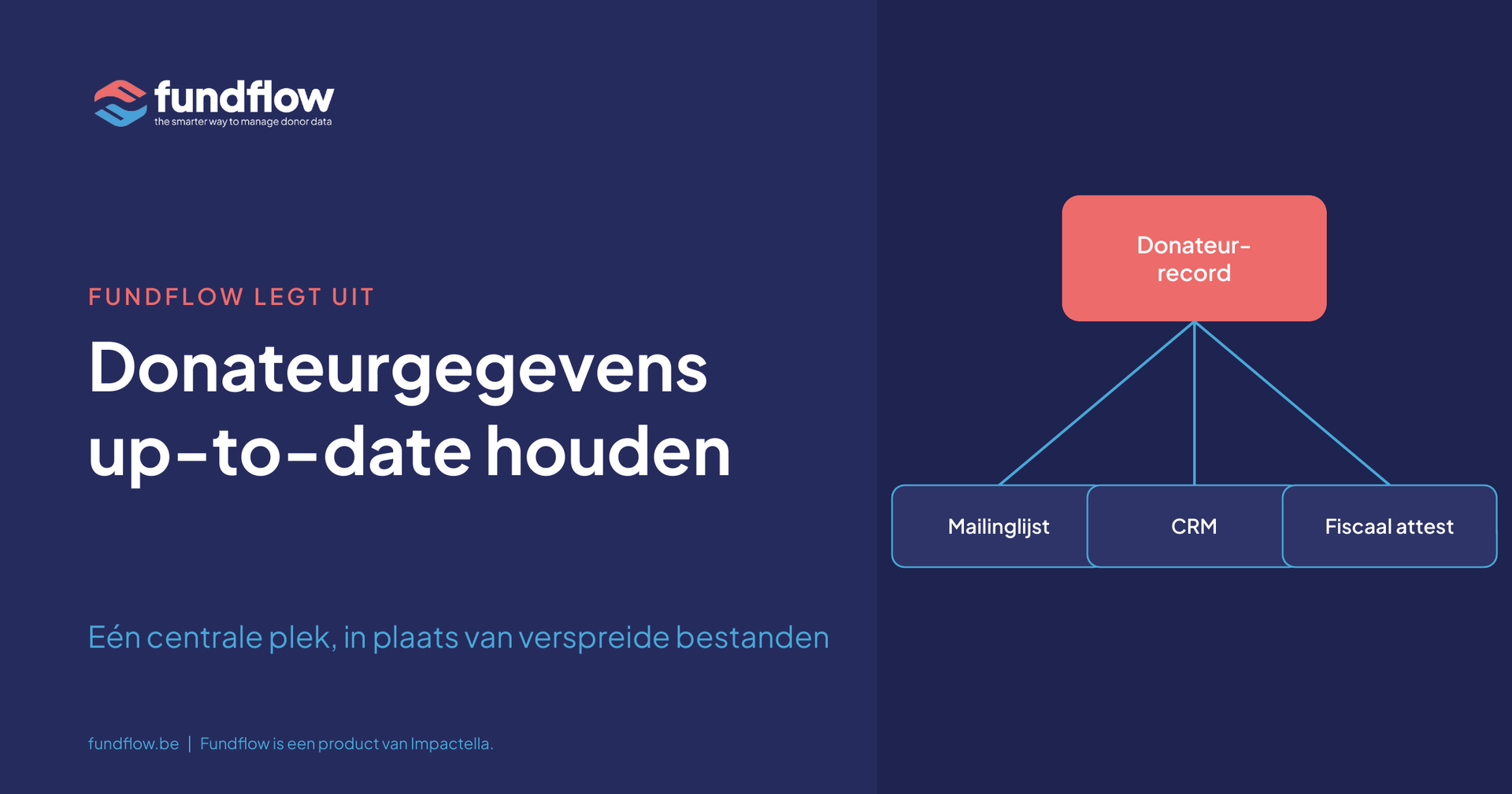
Fundflow werkt als productlaag bovenop Salesforce. De modules voor donatieverwerking, SEPA-domiciliëringen, geautomatiseerde fiscale attesten en Belgische bankbestandsintegratie (CAMT/CODA) zijn al gebouwd. Je configureert ze voor jouw organisatie, maar je bouwt niet van nul.


Dat verschil in aanpak maakt het mogelijk om een migratie van spreadsheets of CiviCRM naar Salesforce met Fundflow realistisch in weken te plannen, niet in maanden. Zonder een technisch team aan de kant van de nonprofit. Zonder uitgebreide specificatiedocumenten.


Wat je wint


Een fondsenwerver die minder tijd kwijt is aan databeheer, heeft meer tijd voor donateurs. Dat klinkt eenvoudig, want dat is het ook.


Met een systeem dat je groei bijhoudt, zie je welke donateurs dreigen af te haken. Fiscale attesten gaan op het juiste moment automatisch de deur uit. Je ziet in één oogopslag welke campagne presteert. Nieuwe medewerkers krijgen een werkend systeem in plaats van een kluwen aan tijdelijke oplossingen die ze maar moeten leren accepteren.


Organisaties die deze stap zetten, zeggen achteraf bijna altijd hetzelfde: we hadden dit eerder moeten doen.


Voor wie is dit relevant?


Voor nonprofits die groeien en de wrijving beginnen te voelen. Voor fondsenwervers die weten dat data door de mazen glipt, maar niet kunnen aanwijzen waar. Voor directeurs die de volgende campagne niet meer op een spreadsheet willen baseren.


En voor organisaties die al een tijd over Salesforce nadenken, maar afhaken op de implementatiekosten en -doorlooptijden.


Fundflow is een product van Impactella, gebouwd door mensen die in de nonprofitsector hebben gewerkt. De Belgische markt, de Belgische bankinfrastructuur, de Belgische fiscale regelgeving: wij kennen ze van binnenuit. En voor nonprofits in Nederland, Frankrijk en Duitsland gelden dezelfde principes.
Person working at a desk with three monitors in a cluttered office, focused on data on the screens

Recent Posts

Person working at a desk with multiple monitors in a cluttered office, focused on data on the screens
by Kris Van Kerkhoven 12 June 2026
Streamline your fundraising with Fundflow's Salesforce integration. Automate gift processing & focus on your mission today!
Scrabble tiles spelling “DATA” on a wooden tabletop, with scattered letter tiles around them
by Kris Van Kerkhoven 12 June 2026
Learn how data quality is vital for AI in nonprofit fundraising. Ensure accurate records ¢tralize systems for better results.
Woman working at a desk with a desktop computer in a bright office, typing and smiling.
by Kris Van Kerkhoven 12 June 2026
Fundflow simplifies Salesforce for Belgian nonprofits, automating gift processing & reducing admin tasks. Streamline your fundraising today!
Fundflow vs Odoo comparison banner with logos and dashboard graphics
by Kris Van Kerkhoven 12 June 2026
Compare Fundflow & Odoo for nonprofit fundraising. Find out which platform suits your needs best. Get started today!
Fundflow and Odoo logos on a blue and beige split background with small line icons
by Kris Van Kerkhoven 12 June 2026
Compare Fundflow & Odoo for nonprofit fundraising. Find the right software for your needs today!
Fundflow vs Odoo comparison banner with logos and dashboard graphics
by Kris Van Kerkhoven 12 June 2026
Compare Fundflow & Odoo for nonprofit fundraising. Evaluate pricing, features & implementation to enhance donor management.
Woman working at a desk with a desktop computer in a bright office, typing and smiling.
by Kris Van Kerkhoven 12 June 2026
Streamline your nonprofit operations with Fundflow's user-friendly Salesforce solution. Save time & focus on your mission today!
Scrabble tiles spelling “DATA” on a wooden surface, with scattered letter tiles around them
by Kris Van Kerkhoven 12 June 2026
Learn how data quality impacts AI in fundraising. Ensure your data is clean to maximize AI benefits. Contact us for more info!
Person working at a desk with three monitors in a cluttered office, focused on data on the screens
by Kris Van Kerkhoven 22 May 2026
The hidden cost of a CRM that can't keep up
Wooden letter tiles spelling “DATA” on a light wood surface with scattered tiles around them
by Kris Van Kerkhoven 20 May 2026
Over the past few months, there has not been a single sector newsletter without a piece on AI in fundraising. Predictive analytics. Personalised donor communication. Automated segmentation. The promises are big, the tools are available, and the enthusiasm is understandable. But there is a conversation that is missing. And it is not about AI.  It is about your data. What AI actually does An AI tool for fundraising does, in simple terms, one thing: it analyses patterns in your historical data and uses those patterns to make predictions. Who is likely to give again? Who is ready for a larger gift? Who is at risk of lapsing? That sounds powerful. And it is, when the data those predictions are based on is reliable. But if your database is full of duplicate records, outdated addresses, gifts not linked to the right campaign, or donors with no communication history, the tool does not give you insights. It gives you errors, at scale, generated automatically. Garbage in, garbage out. That principle is as old as computers themselves. It applies to Excel. It applies to the most sophisticated AI tool on the market. The reality at many nonprofits This is not a theoretical problem. At many nonprofits, including organisations that have been running professional fundraising operations for years, the data often looks like this: The same donor appears three times in the system, under slightly different names or addresses. Gifts are recorded, but without a link to the campaign they came from. SEPA mandates live in a separate spreadsheet, not in the CRM. Communication history is scattered across multiple tools that never spoke to each other. That is not the result of negligence. It is the result of years of getting by with too little time, too few people, and systems that were never built for what you eventually needed them to do. The honest sequence Before a nonprofit invests in AI tools, there is work to be done. Not glamorous work. But the work that determines whether that investment pays off later. In practice, that means three things. Get your basic registration right. Every gift correctly linked. Every donor appearing once in the system. Communication preferences recorded. That is not a nice-to-have. It is the foundation. Centralise your data. Your fundraising, your direct debit mandates, your communication history: these belong in one system, not spread across a CRM, a spreadsheet, and three Mailchimp exports. As long as data lives in silos, no analytical tool can do anything useful with it. Ask the right questions of your data first. Who has not heard from you in the past 12 months? Who has given for five consecutive years but never had a personal touchpoint? These are questions your CRM should be able to answer today, without AI. If it cannot, AI is not yet on the agenda. Then, and only then: AI Once that foundation is in place, AI tools for fundraising genuinely add value. Predictive models that estimate who is ready for a major gift. Smart segmentation that adjusts automatically based on donor behaviour. Personalised communication that scales without losing relevance. But the tool is the last step, not the first. The nonprofits that will get the most out of AI in the coming years are not the ones that bought a tool earliest. They are the ones that got their data in order first. That is the honest message. Less glamorous than the AI stories in your newsletter. But the right one.
Show More