Over the past few months, there has not been a single sector newsletter without a piece on AI in fundraising. Predictive analytics. Personalised donor communication. Automated segmentation. The promises are big, the tools are available, and the enthusiasm is understandable.
But there is a conversation that is missing. And it is not about AI.
It is about your data.
What AI actually does
An AI tool for fundraising does, in simple terms, one thing: it analyses patterns in your historical data and uses those patterns to make predictions. Who is likely to give again? Who is ready for a larger gift? Who is at risk of lapsing?
That sounds powerful. And it is, when the data those predictions are based on is reliable.
But if your database is full of duplicate records, outdated addresses, gifts not linked to the right campaign, or donors with no communication history, the tool does not give you insights. It gives you errors, at scale, generated automatically.
Garbage in, garbage out. That principle is as old as computers themselves. It applies to Excel. It applies to the most sophisticated AI tool on the market.
The reality at many nonprofits
This is not a theoretical problem. At many nonprofits, including organisations that have been running professional fundraising operations for years, the data often looks like this:
- The same donor appears three times in the system, under slightly different names or addresses.
- Gifts are recorded, but without a link to the campaign they came from.
- SEPA mandates live in a separate spreadsheet, not in the CRM.
- Communication history is scattered across multiple tools that never spoke to each other.
That is not the result of negligence. It is the result of years of getting by with too little time, too few people, and systems that were never built for what you eventually needed them to do.
The honest sequence
Before a nonprofit invests in AI tools, there is work to be done. Not glamorous work. But the work that determines whether that investment pays off later.
In practice, that means three things.
Get your basic registration right. Every gift correctly linked. Every donor appearing once in the system. Communication preferences recorded. That is not a nice-to-have. It is the foundation.
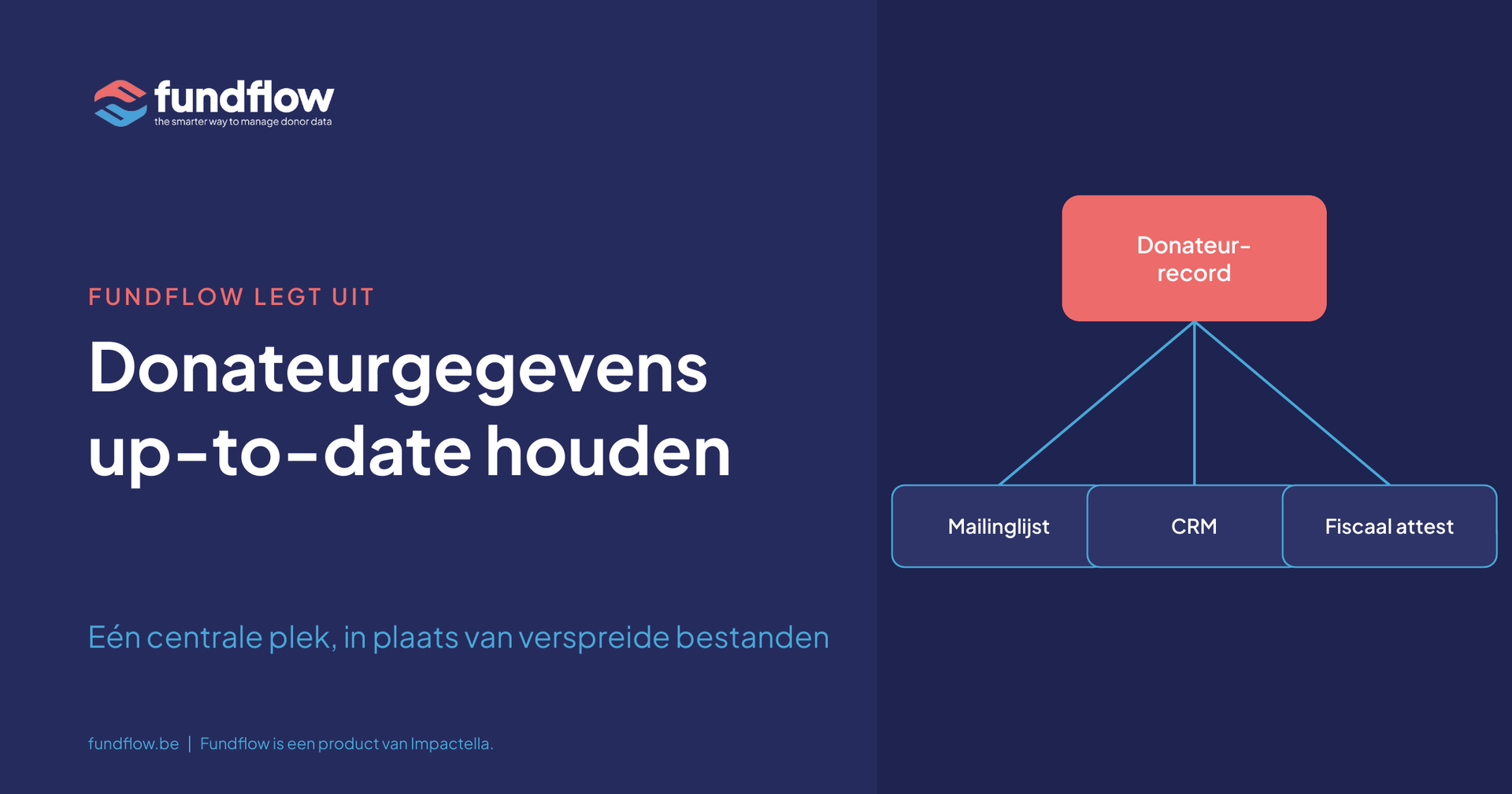
Centralise your data. Your fundraising, your direct debit mandates, your communication history: these belong in one system, not spread across a CRM, a spreadsheet, and three Mailchimp exports. As long as data lives in silos, no analytical tool can do anything useful with it.
Ask the right questions of your data first. Who has not heard from you in the past 12 months? Who has given for five consecutive years but never had a personal touchpoint? These are questions your CRM should be able to answer today, without AI. If it cannot, AI is not yet on the agenda.
Then, and only then: AI
Once that foundation is in place, AI tools for fundraising genuinely add value. Predictive models that estimate who is ready for a major gift. Smart segmentation that adjusts automatically based on donor behaviour. Personalised communication that scales without losing relevance.
But the tool is the last step, not the first.
The nonprofits that will get the most out of AI in the coming years are not the ones that bought a tool earliest. They are the ones that got their data in order first.
That is the honest message. Less glamorous than the AI stories in your newsletter. But the right one.