
Nearly 8 in 10 Belgians want maximum impact per euro. That return is won in the work nobody sees.
The latest Barometer of Philanthropy includes a statement that was tested for the first time in 2025: charities should above all deliver the highest possible return and make the biggest difference per euro donated. 77% of Belgians agree.
Three quarters of the country, then, hold a clear expectation about what happens to their money.
It's tempting to read distrust into that number. But that picture doesn't hold up. The same Belgian still believes in giving itself. Nearly 8 in 10 think a gift contributes to a better world. 81% call philanthropy socially important. And 60% actually gave in 2025. Belgians believe in charities and hold them to a standard at the same time. Both, together.
What's behind that expectation
A shift in giving behaviour makes this expectation sharper. Income from donations has grown for years, but that growth comes mostly from more gifts, not bigger ones. The average gift amount, adjusted for inflation, has stayed remarkably stable.
For a fundraiser, that has a very concrete consequence. You manage more donors for roughly the same average amount. More relationships to follow up well, without the value per relationship rising. And that is exactly where your return per euro gets decided: in how well you manage that growing group.
Return isn't won on stage
When organisations think about return, the conversation often centres on the visible side: the campaign and the story around it. That matters, but it's not where most euros leak away.
The difference gets made in three places no one puts on a poster.
Administration. Every hour spent manually logging gifts, generating tax certificates, and reconciling bank files is an hour, and a euro, that doesn't go to the mission. The number of tax-deductible gifts is at a historic high, so this work is real and it keeps piling up. Automate it, and that time goes back to donors and programmes.
Retention. When growth comes from volume, a donor you quietly lose is your most expensive leak. Keeping an existing donor costs a fraction of finding a new one. Yet many organisations still put most of their budget into acquisition and the smallest share into the people who already said yes.
Trust. The barometer still lists mismanagement as a reason not to give, even though that figure has been dropping for a few years. A donor who sees their gift land well gives again. Return and trust reinforce each other. Organisations that work efficiently and transparently keep donors longer.
What a CRM solves, and what it doesn't
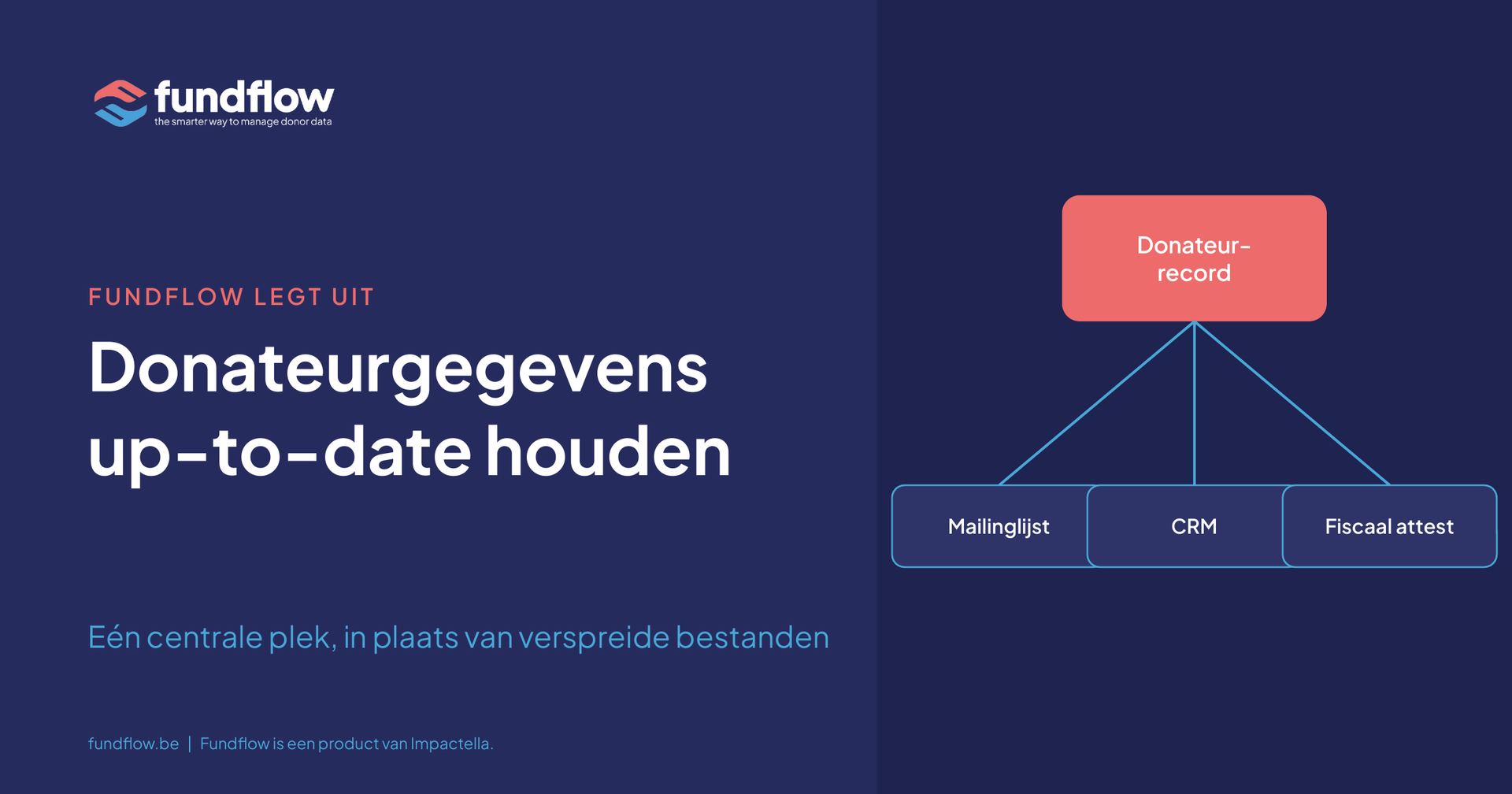
Those three things, donor data, automated administration, and a retention approach, come together in one place: your CRM. That's where return per euro gets won or lost in practice.
We'd rather be honest about that. A CRM isn't a cure-all. A heavy system nobody uses costs more than it delivers. It only helps when it fits how an organisation actually works, and how the people using it every day actually work. Technology only earns its place when it lightens the workload and frees up time for donors and programmes.
What that 77% is really asking for
That 77% isn't asking charities to cut back on their mission. They're asking for careful stewardship of every euro that comes in. For the sector, that's an invitation: take the invisible side of the work as seriously as the campaign. Administration and the relationship with your donors together decide how much of every euro actually reaches the mission.
Because that's where the biggest difference per euro gets made: in the least glamorous part of the work.
Where does most of your return leak away: in acquisition, or in keeping the donors you already have?
Source: Barometer of Philanthropy, 8th edition (Philanthropy Index by Itinera and Philanthropy Survey by Ipsos, n=1,002). Giving behaviour figures relate to 2025.